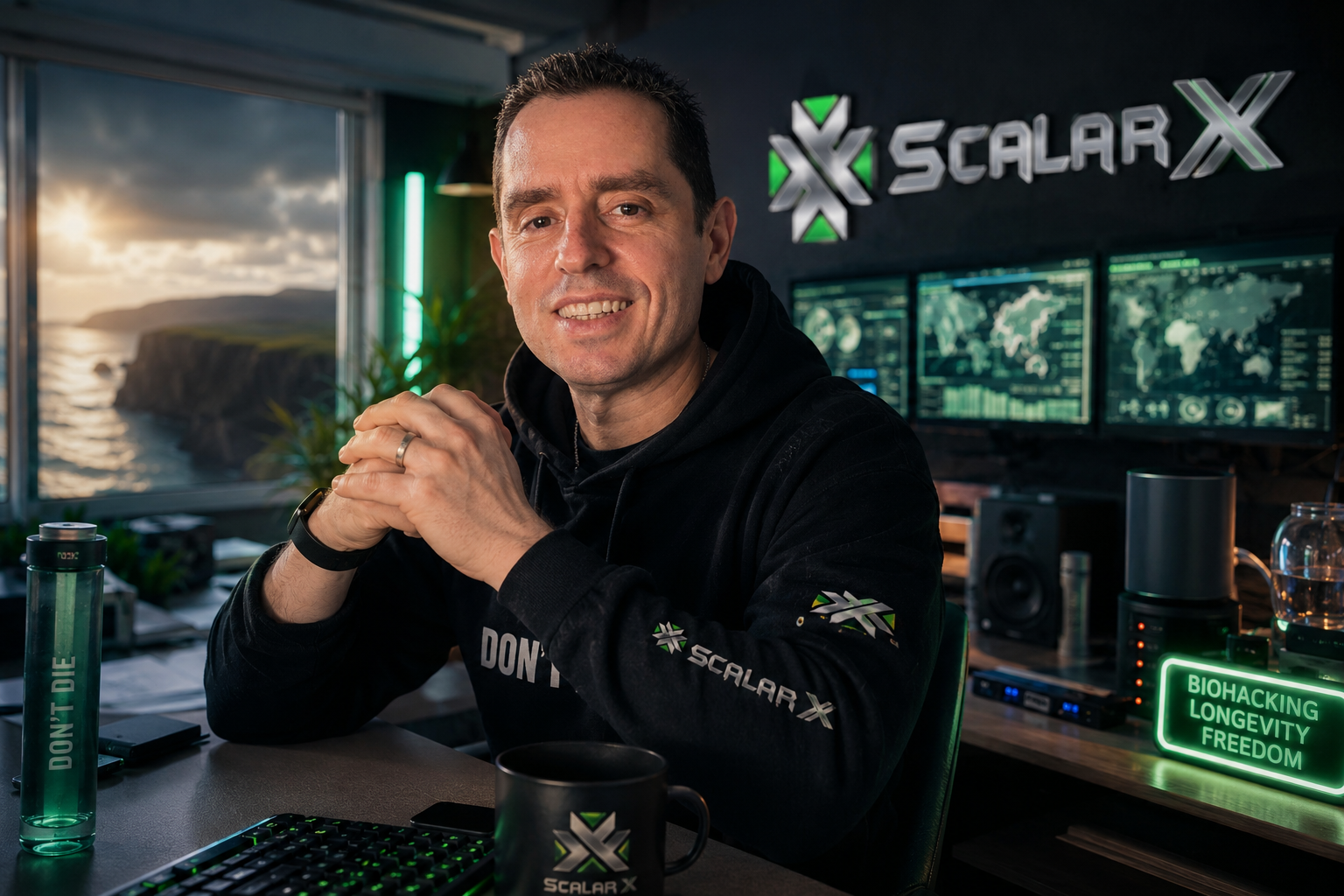
I founded ScalarX in 2015, nearly sixteen years after creating my first company, Digital Network, in 1999.
For more than a quarter of a century, I have worked with companies, institutions, entrepreneurs, engineers, and technical teams as they addressed a wide range of problems: security, infrastructure failures, fires, failing operations, crisis communications, performance, continuity, decision-making, or transformation.
Over the years, I have observed one constant: many situations considered critical, complex, or impossible to solve do not stem from a fundamental difficulty, but from an accumulation of poorly understood complexity, delayed decisions, technical debt, scattered information, invisible dependencies, unclear responsibilities, or promises disconnected from the real world.
I have seen companies lose time, money, focus, and sometimes part of their future because of problems that could have been anticipated, scoped, documented, automated, or simply understood sooner.
ScalarX was born from this observation.
I initially created ScalarX as an applied research and development laboratory, self-funded through the business of solving complex problems. The objective was already clear: use technology to design useful, intelligent, concrete solutions capable of improving the way companies operate over the long term.
The technologies developed within ScalarX were then used or marketed through other companies and ventures that I ran or participated in. ScalarX was the laboratory, the place where we explored, built, and tested what did not yet exist elsewhere.
Behind this approach was a conviction I have never abandoned: science and technology are the most powerful tools at our disposal to transform the real world, augment our capabilities, and build a better future.
I no longer believe that governments or politics are capable of building the technological foundations on which our future will depend. They can try to administer what already exists, regulate it, slow it down, tax it, or sometimes attempt to protect it. Even so, I hold a deep conviction: the great transformations ahead, including those of governments themselves, will be built by private actors capable of deciding, investing, experimenting, taking risks, and above all, executing.
These foundations must be built by private companies like ScalarX.
In early 2020, I was diagnosed with an autoimmune disease considered incurable: a severe form of Crohn’s disease. This diagnosis profoundly changed my relationship with time, priorities, limits that are too easily considered permanent, and the need to build now rather than wait for an ideal moment that never comes.
At the end of 2021, I left my positions in my previous ventures, and during the summer of 2022, I refocused fully on ScalarX.
I began with my consulting work and my "Better Call Brain" sessions. Then the time came to dive back into managed infrastructure, cybersecurity, cloud, technical support, and 24/7 operations, which gradually became the visible foundations of this new phase. These are fields I have known for a long time, within my "comfort zone," as they say, but above all fields that do not tolerate illusions for long.
A poorly designed architecture eventually becomes expensive. Neglected security eventually comes at a price. Fragile automation eventually breaks at the worst possible time. A poorly understood dependency eventually becomes a bottleneck, and a commercial promise disconnected from reality always ends up creating an operational problem.
That is why infrastructure makes an excellent starting point. It forces us to understand the layers, dependencies, risks, responsibilities, performance, and concrete consequences of every decision.
But ScalarX was never meant to remain confined to a single definition of its business.
Managed infrastructure is a foundation, not a boundary.
From these foundations, we build platforms and technological capabilities for understanding, designing, operating, securing, automating, improving, and transforming. ScalarX does not simply sell machines, cloud, scripts, or human time. We build systems as products that must work in the real world, remain controllable, and make those who use them more autonomous, faster, and more capable.
I believe in technological independence, portability, autonomy, and genuine control over systems. A technology that can no longer be understood, moved, replaced, or brought back under control sooner or later becomes a dependency. This is why we favor open, provider-agnostic architectures that can operate across different infrastructures and are designed to avoid unnecessary lock-in as much as possible.
I do not believe in companies that confuse innovation with communication, any more than I believe in organizations that add artificial intelligence to confused processes in an attempt to appear modern.
AI does not magically fix an organization that does not understand what it is doing. It does not turn a bad decision into a good one, nor does it replace competence, judgment, or responsibility.
Used correctly, however, it changes the game profoundly.
It allows us to understand better, document better, compare better, automate better, decide better, and act better. It radically shortens the distance between an idea and its execution, allows small teams to build what once required much larger organizations, and redistributes the power to act toward those who truly know how to use it.
It is within this logic that, since February 2026, I have undertaken the transformation of ScalarX into a "Singularity Company."
A Singularity Company is not a conventional company to which a few AI assistants, a chatbot, and some automation have been added. It is a company structured around intelligence, capable of better understanding its own operations, clients, decisions, errors, knowledge, constraints, and capabilities, so that every useful action can strengthen the system instead of disappearing into an email, a ticket, a meeting, or one person’s memory.
Such a company does not merely learn. It builds the conditions that allow it to improve itself.
An incident must not merely be resolved; it must make the next one less likely or easier to handle. A recurring request must be able to improve an offering. An important decision must leave a usable record. A procedure must be able to become a tool, a tool a standard, and a client experience a reusable operational advantage.
It is also within this logic that I am building Elora, my strategic AI partner.
Elora is neither a chatbot, nor a model, nor another agent, nor an attempt to replace my judgment with that of a machine. She is a layer of continuity, context, memory, routing, analysis, decision support, and execution, capable of coordinating different models, agents, tools, and humans without being confused with them.
Models produce, agents execute within their boundaries, tools apply deterministic paths when they exist, Elora maintains the coherence of the whole, and the operator retains authority.
Building Elora now serves as an operational laboratory for part of ScalarX’s transformation. She makes a fundamental conviction concrete: intelligence, whether human or artificial, only becomes truly useful to an organization when it has structured context, reliable memory, explicit responsibilities, controlled execution paths, and clearly defined authority.
This transformation is not about removing humans to replace them with agents. It is about removing useless tasks, information loss, absurd repetition, artificial delays, blind spots, and limits that are no longer justified.
It also shifts human value.
In a world where AI can quickly produce text, code, analyses, images, plans, and automation, value no longer lies solely in the ability to produce. It shifts toward the ability to understand the problem, formulate the objective correctly, choose the right tools, verify the results, identify the risks, make a decision, and accept its consequences.
Technology must augment humans, not make them passive.
ScalarX likes problems that others declare too complex, too atypical, or too difficult. Not for the sake of posturing, but because many things considered impossible are simply poorly scoped, poorly understood, poorly funded, or poorly executed.
ScalarX exists to build solutions that are simple when possible, robust when necessary, portable by design, and effective in the real world.
Our ambition is not to follow the technological transformation underway, but to drive it by building a company capable of actively shaping it with clarity, high standards, and responsibility.
Christophe Casalegno
Founder and CEO, ScalarX
Do you have a complex problem to scope or critical infrastructure to make more reliable?
Describe the context, constraints, and objective: we will help you distinguish what is possible, useful, risky, or a priority.